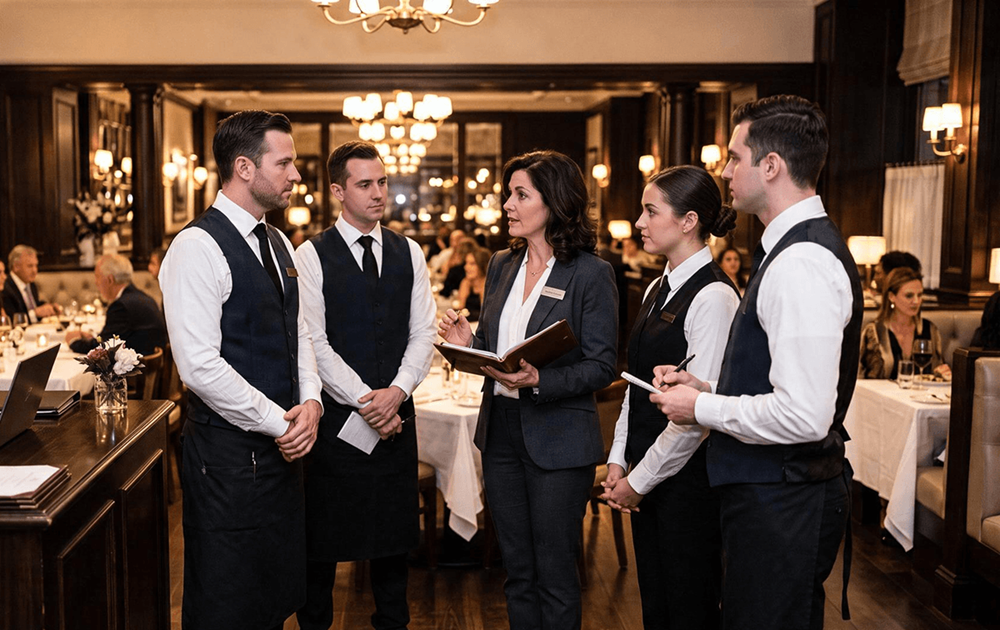
Summer in the Gulf is not like other times of the year. Most Gulf F&B operators respond by cutting hours, managing around skeleton crews, and waiting for September. That approach keeps the lights on. It rarely moves the business forward.
Restaurant team management in the slow season is less about minimizing losses than about choosing what to invest in. The operators who come out of Q3 ahead use the quiet period deliberately, starting with the team.
What follows covers practical areas for Gulf restaurants navigating slow-season staffing.
Cross-Train Instead of Just Cutting Hours

When footfall drops, the instinct is to reduce shifts. That’s reasonable. Labor cost is the lever most operators reach for first. But cutting shifts without intention wastes the one asset the slow season gives you: available time.
A server who normally runs three sittings on a Friday evening has real capacity during a quiet Tuesday lunch. That time can go toward learning the reservation system properly, shadowing the floor manager, or getting trained on guest feedback workflows for the first time. None of this requires a formal program. It requires someone deciding what skills the team is missing and assigning them deliberately during quieter shifts.
Cross-training also changes the team’s experience of summer. The staff members who stay through slow months tend to be the ones who feel the investment. A team member who learns something new in July has a reason to return in September. They also perform better when covers pick back up. Teams that know the operation well are better at turning residents into regulars, and that is where long-term revenue comes from.
Set Development Goals, Not Just Coverage Goals

Most scheduling conversations in slow season focus on coverage: who is on, when, and at what cost. That conversation is necessary. But operators who use summer well also have a second conversation: what do we want this team to be capable of by September?
The answer doesn’t need to be ambitious. It might mean one team member taking ownership of a process: private dining coordination, dietary preference tracking, or the group booking workflow. It might mean a floor manager running a weekly guest feedback review for the first time. Small, specific, achievable. The goal is one improvement that sticks.
Operators who frame the slow season around development goals also make better use of their managers. A head of operations with lighter service volume can observe, coach, and correct. None of that is possible when the restaurant runs at full capacity. That visibility is rare. It should be used.
Run Performance Reviews While There Is Still Time to Act
Performance reviews rarely happen during peak season. Service volume is too high, managers are too stretched, and the conversation gets pushed back indefinitely. July removes that excuse. The bandwidth is there. The question is whether operators use it.
A structured review in July does two things that an October review cannot. First, it gives the team member a clear picture of where they stand before the pressure returns. Second, it gives the manager something to actually follow up on — a skill gap to close, a responsibility to expand, a behavior to address — while there is still time in the season to see whether it changed. Feedback delivered in October, when the restaurant is already at capacity, is harder to act on and easier to ignore.
Reviews do not need to be formal to be effective. A 30-minute conversation per team member, with one specific piece of feedback and one forward-looking goal, is enough. What matters is that it happens and that the team member walks away knowing where they stand. That clarity is also a retention signal. People who receive genuine feedback tend to stay. People left in the dark about their standing are more likely to take other options when hours are reduced.
Adjust the Schedule Without Losing the Team

Reducing hours creates financial relief but a retention problem if you overdo it. The staff members who can absorb a steep cut in availability are the ones with options. If their hours drop far enough, they take other work. Some don’t come back.
In the US food service market, annual staff turnover runs at roughly 75%, according to Homebase. Gulf markets have different dynamics, but the underlying pattern holds. Slow seasons are when operators lose people they didn’t mean to lose. Replacement costs run higher than the monthly P&L suggests. Recruiting, onboarding, and the productivity gap while a new hire gets up to speed all add up quietly.
A practical fix: communicate the schedule further in advance than usual. Give the team a three-to-four week window into their upcoming hours so they can plan around the reduction. Be transparent about when volume will recover. A staff member who knows their hours will be lower for six weeks — and knows when that ends — is different from one who feels quietly phased out. The first stays. The second often doesn’t.
Prepare the Autumn Surge Before August Ends
Gulf restaurants that manage well through the slow season don’t wait for demand to return before preparing for it. Mid-to-late August is when hiring gets competitive. Onboarding takes time operators no longer have at that point.
Operators who use July to map their September roster and identify gaps arrive at peak season ready. Reaching out to former team members who left on good terms is worth doing in July too, before August hiring gets competitive and their availability narrows. Those who wait until reservations pick up spend the first weeks of Q4 short-staffed. They run on an undertrained team and absorb the guest experience cost of that gap.
The same logic applies to systems and processes. If reservation flow, waitlist handling, or guest data capture needs adjusting before September, July is the time to do it. Fixing a broken process during peak season costs more — in staff confusion, guest friction, and covers lost — than addressing it when the restaurant is quiet.
The Slow Season Is a Choice
Every Gulf restaurant experiences reduced volume in July and August. What differs is what operators do with it. Teams that arrive in September more capable and more stable share something in common. Their managers treated the slow months as an investment period, not a holding pattern.
Smart restaurant team management in the slow season comes down to three decisions. Choose development over pure cost-cutting. Communicate clearly and early. Plan for September before it arrives. None of these require budget; they require intention.