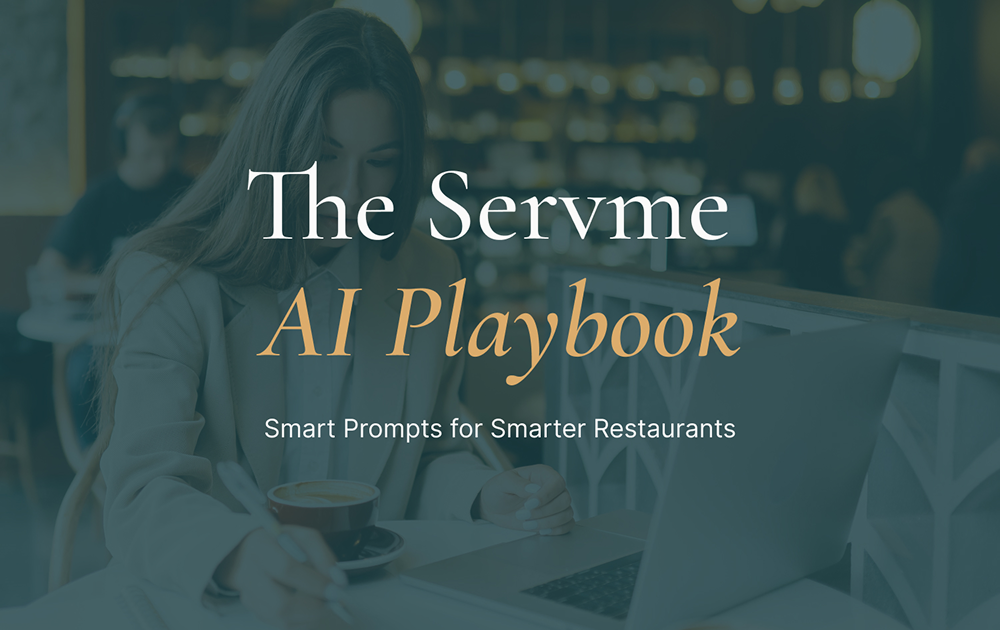
Restaurant operators want to use AI. Too many are doing it wrong. The Servme AI Playbook for Restaurants is a free guide for operators who want to close that gap.
The tools are accessible, most are free, and the intentions are real. The problem is the approach. Most operators type into AI the way they would type into a search engine — a general question, a vague request — and get back a general answer. Useful enough to not delete. Not useful enough to change anything.
The Real Source of the Gap
According to a 2026 Popmenu study, 44% of operators are already using AI, with another 25% planning to adopt AI tools this year. Adoption is not the problem. How operators are using it is.
AI outputs reflect the quality of the inputs. A vague question produces a vague answer, technically competent, contextually useless. No guest will feel that “Write a birthday email for a restaurant guest” was written for them, because it wasn’t. There is no brand voice in that instruction. No guest history. No sense of what the venue is actually like or what outcome the email is supposed to drive.

The same task, written with specificity — who the guest is, what relationship they have with the venue, what the email should make them do next, what tone the brand speaks in — produces something a guest opens, reads, and acts on. The AI did not get smarter. The prompt did.
This is the adoption gap: a lack of a framework for asking AI the right things. In hospitality, where every guest interaction is an opportunity to build loyalty or lose it, that gap has a cost.
Where It Shows up Across a Restaurant Operation
The gap runs across every function where AI could be saving time or improving outcomes instead of producing skimmed and discarded outputs.
- In guest experience, AI can help orchestrate exceptional moments for individual guests: proposals, milestone celebrations, service recovery situations. But it needs enough context about the specific guest, the specific setting, and the specific outcome you are trying to create. Generic inputs produce generic hospitality suggestions. The kind any guest could see through.
- In operations, AI can identify inefficiencies in closing procedures, redesign prep workflows, and generate staff training scenarios tailored to your actual service gaps. For that, it needs your current checklist, your specific weak points, your constraints. Without that context, it produces theory instead of a plan your team can execute tomorrow morning.
- In marketing, the difference between a broadcast email and a segmented one matters. A single AI session can generate four versions of the same announcement, each written for a different guest relationship. But only if the prompt defines the segments, the relationship, and the angle each version should take. Operators who send undifferentiated email to their entire list are not missing the AI tools. They are missing the prompt.
- In menu development, small changes to item descriptions and positioning can meaningfully shift average check value. AI can run that analysis on your specific menu using established menu engineering principles. However, the menu should be pasted in and the task defined with enough precision to produce actionable recommendations rather than general advice about food writing.
The Servme AI Playbook for Restaurants
We built the Servme AI Playbook for Restaurants to close that gap. It is a free, practical guide designed specifically for restaurant teams, with a set of tools for the specific situations operators face daily, not a general AI tutorial.
The guide introduces a prompt structure framework that turns generic questions into specific, strategic inputs. It then applies that framework across four areas: guest experience and personalization, operations and staff efficiency, marketing and social media, and menu development. It also provides eight ready-to-use prompts that can be customized to your venue and used immediately.
Each prompt in the guide is built around a real operational challenge. Not a theoretical use case, but the kind of situation your team encounters in a normal service week: a guest complaint that needs a recovery strategy beyond a discount; a staff training session that needs scenarios tailored to your actual weak points; an influencer collaboration that should be more than a free meal.
The guide also addresses how to build on first outputs, because AI improves with iteration. A team that knows how to refine a prompt gets progressively better results from the same tool. The goal is to make AI a shared operational capability across your team, not a management experiment that never scales.
What Changes When the Gap Closes
AI does not replace the hospitality instinct your team has built over years. It removes the friction that gets in the way of using it. The time spent drafting a staff briefing, writing a re-engagement campaign, redesigning a closing checklist, or workshopping menu descriptions goes back to guests. That is what the operators on the right side of the gap have found: not that AI does their job, but that it frees them to do it better.
The Servme AI Playbook for Restaurants is designed for teams that want to move from experimenting with AI to actually working differently because of it. You can download it for free below or book a demo with Servme directly.