Guests make restaurant decisions based on what they see online before they ever walk through your door. According to BrightLocal’s Local Consumer Review Survey 2026, 97% of consumers read reviews for local businesses and 85% say positive reviews make them more likely to visit. Nearly half (49%) trust online reviews as much as a personal recommendation from someone they know.
A strong social presence, consistent review management, and well-timed marketing campaigns are not optional extras; they are how new guests find you and how regulars decide to come back. The right tools help you do this without adding more manual work to an already stretched operations team. Here are ten categories worth having in your restaurant’s marketing stack, with practical guidance on what to look for in each.
1. Social Media Management Tools
For restaurants, social media is primarily a visual channel. Instagram and TikTok drive more direct guest decisions than LinkedIn or Twitter — a well-lit plate or a kitchen video reaches the right audience in a way that a text post cannot. Social media management tools let you schedule content across platforms in advance, so posting stays consistent even during busy service periods.
Look for a tool with built-in analytics that shows which content types drive the most engagement for your specific account, not just vanity metrics like impressions, but saves, profile visits, and link clicks. That data tells you what to make more of.
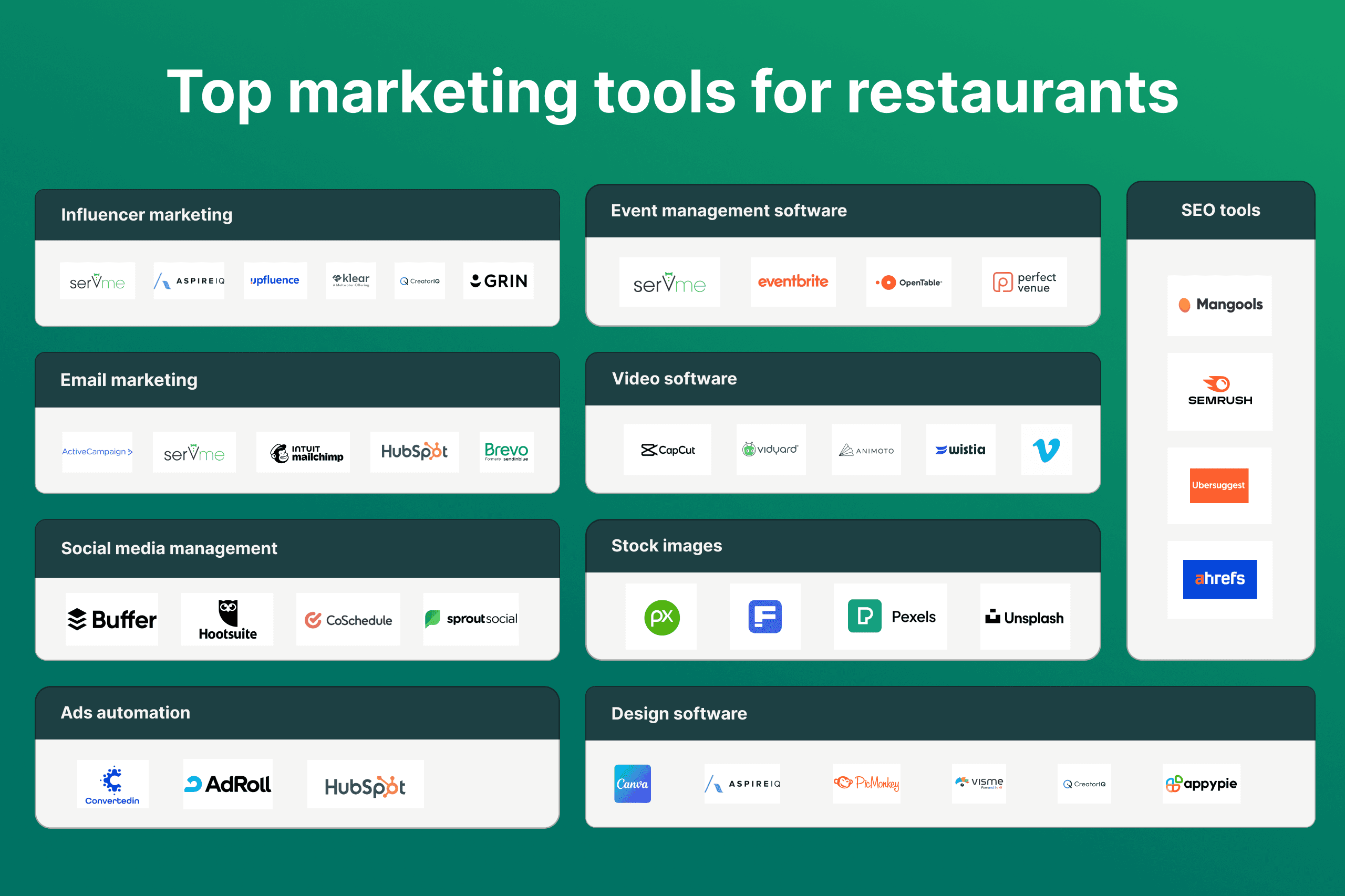
Popular options: Later, Buffer, Hootsuite, Sprout Social, CoSchedule
2. Ad Automation Tools
Paid advertising is most effective for restaurants when it targets people who already have some connection to the venue — guests who visited your website or booking page but did not convert, or lookalike audiences built from your existing guest data. The starting point for most restaurants is Meta Ads Manager and Google Ads: both are free to use (you pay only for the ads themselves), and between them they cover the two largest paid channels for local restaurant discovery.
Start with retargeting before scaling to cold audiences. A guest who visited your reservations page is far more likely to convert than someone who has never heard of the venue. Third-party automation tools layer on top of these platforms to help manage campaigns at scale, particularly useful for operators running multiple outlets or promotions simultaneously.
Popular options: Meta Ads Manager, Google Ads, HubSpot, Convertedin, AdRoll
Learn more about marketing automation for F&B here.
3. Email Marketing
Email, such as newsletters, remains one of the highest-return marketing channels available to restaurants. Unlike social media, where your content competes in an algorithm-controlled feed, an email lands directly in the inbox of a guest who opted in to hear from you. The all-industry average open rate is around 35% (Mailchimp, December 2023), higher for well-segmented restaurant lists where guests recognize the sender.
The practical tip: email marketing works significantly better when it is connected to your reservation system. Campaigns segmented by visit history, last visit date, or occasion type consistently outperform generic blasts to the full subscriber list. If your email tool and your reservation platform are separate, you are leaving that segmentation on the table.
Popular options: Servme, Mailchimp, HubSpot, Brevo, ActiveCampaign
4. Messaging: SMS & WhatsApp
Direct messaging channels are the right tool for time-sensitive guest communication: booking reminders sent a few hours before a reservation, same-day promotions for available tables, post-visit feedback requests. Messages are seen quickly, which is exactly why they work for restaurants: the communication lands at the moment it is most relevant.
SMS works well in most markets and requires no app. WhatsApp is the dominant channel in MENA (penetration in markets like the UAE and Saudi Arabia is above 90%) and unlike SMS, it supports images, PDFs, and two-way conversation. For restaurants in these markets, WhatsApp is often the primary guest communication channel, not a secondary one.
The practical tip: frequency matters more with direct messaging than with email. More than two or three messages per month from the same sender drives opt-outs faster than any other channel. Keep this channel reserved for high-value, genuinely time-sensitive sends.
Popular SMS options: Servme, Unifonic, Bird, SimpleTexting
Popular WhatsApp-approved API partners: Servme, Unifonic, Bird
5. Influencer Marketing
Influencer collaboration has become a standard part of the marketing mix for F&B venues, particularly those targeting younger demographics. According to The Influencer Marketing Benchmark Report 2024, 85% of marketers consider it an effective form of marketing.
For restaurants, the practical tip is to prioritize local relevance over follower count. A food blogger with 30,000 followers in your city will drive more reservations than a global food account with 500,000 followers spread across markets where you don’t operate. In MENA specifically, local and regional food creators, including those who travel between markets, tend to deliver higher conversion to actual visits than purely international content.
Set a clear brief and defined expectations before any collaboration: what content, which platforms, what timeline, and how you will track results.
Popular options: Aspire, Upfluence, Meltwater, Grin, CreatorIQ
6. Design & Visual Content Tools
High-quality visuals are non-negotiable for restaurant marketing. Before a guest decides whether to visit, they decide based on what they see, and a consistent visual identity across your social media, email campaigns, and menus builds the kind of recognition that makes a venue memorable.
Design tools like Canva let you create on-brand content without a dedicated designer: set your brand colors, fonts, and template structure once, then reuse them across every post and campaign. For stock imagery, Pexels, Unsplash, and Pixabay offer free options when original photography is not available, though own photography will always outperform stock for food content. A single professional food shoot pays back across months of content.
Popular design options: Canva, PicMonkey, Visme
Free stock image libraries: Pexels, Unsplash, Pixabay, Freepik
7. Video Creation Tools
Short-form video has become the highest-reach content format on Instagram and TikTok, and for restaurants, it is one of the most effective ways to show the experience rather than describe it. According to Wyzowl’s State of Video Marketing research, the majority of marketers report that video has directly contributed to increased sales and improved brand awareness.
The practical tip: production quality matters less than content quality for short-form video. A well-lit phone video of a dish being plated, a kitchen moment, or a table being set for a special occasion consistently outperforms polished branded content in terms of organic reach on Reels and TikTok. Video creation tools help with editing, captioning, and formatting for different platforms without requiring professional production.
Popular options: CapCut, Animoto, InShot
For hosting longer-form video content on your website: Vimeo
8. SEO Tools
For restaurants, local SEO matters more than general SEO. A guest searching “Italian restaurant near me” or “best brunch in Dubai Marina” is ready to book, so ranking for those searches has a direct, measurable impact on covers. Your Google Business Profile is the single most important SEO asset a restaurant has: keep it current with accurate hours, updated photos, your menu, and responses to reviews.
SEO tools help you identify which search terms bring guests to venues like yours, find gaps in your website content, and track how your rankings change over time. Most offer a free trial, useful for a first audit before committing to a subscription.
Popular options: Google Search Console (free), Semrush, Ahrefs, Mangools, Ubersuggest
9. Event Management Software
Hosted events (private dining, ticketed dinners, seasonal activations, corporate bookings) are one of the most effective marketing levers available to restaurants. They fill covers during typically slower periods, attract guests who may not have visited otherwise, and generate the kind of shareable, occasion-driven content that performs well on social media. A well-promoted event also builds your email list: every attendee is a guest profile you can market to again.
Event management tools matter here because they handle the ticketing, RSVPs, and guest communication in a way that keeps attendee data structured and usable rather than scattered across spreadsheets and inboxes.
The practical tip: prioritize tools that feed event attendees back into your core guest database. A sold-out chef’s table dinner is a marketing asset only if you can reach those guests again for future events and campaigns.
Popular options: Servme, Eventbrite, Perfect Venue
10. Reputation & Review Management Tools
Online reviews are one of the primary signals that influence a new guest’s decision to book. Most operators know this, but few act on it systematically. Review management tools aggregate feedback from Google, TripAdvisor, and delivery platforms into a single dashboard, so nothing goes unread and responses go out promptly.
The practical tip: responding to reviews — positive and negative — signals to Google that the business is active, which directly improves local search visibility. Response rate matters more than response quality: a brief, genuine reply to a negative review is more effective than a lengthy one that arrives two weeks later. For venues with multiple outlets, reputation tools make managing reviews across locations manageable without a dedicated team.
Popular options: Google Business Profile (free), Servme, Birdeye, Podium, Yext, Reputation.com
Using Servme for Restaurant Marketing
Several of the tools above (email marketing, SMS, WhatsApp messaging, event management, and guest segmentation) are built directly into Servme. Because they share the same guest database as your reservations and CRM, campaigns can target based on actual visit history, spend level, and occasion data without any manual export or list management.
For operators who want to consolidate their marketing stack, Servme handles the guest communication channels most relevant to F&B, so your team spends less time switching between platforms and more time focused on the guest experience.
Frequently Asked Questions
Do I need all ten of these tools?
No. Start with the channels where your guests already spend time and the tools that solve your most immediate problem, whether that is inconsistent social posting, low review response rate, or email campaigns that are not driving bookings. Adding too many tools at once creates more work than it solves. Build the stack gradually, starting with the two or three categories that have the clearest impact on your venue.
Is a menu a marketing tool?
Yes, your menu is one of your most viewed marketing assets. It communicates your concept, price point, and cuisine before a guest ever visits. A well-designed digital menu, kept current and easy to find online, affects both SEO and the decision to book. We cover digital menus and related software in our restaurant tech stack article.
See how Servme combines email, SMS, WhatsApp, and guest marketing in one platform built for F&B operators. Book a free demo here.